How to start a skip hire business in 2027, with real costs
The licences, vehicle, skips, yard, insurance and tip account you need to start a skip hire business, in the order you need them, with current cost ranges and a first-year budget.

LoadSnap team
Running a waste business
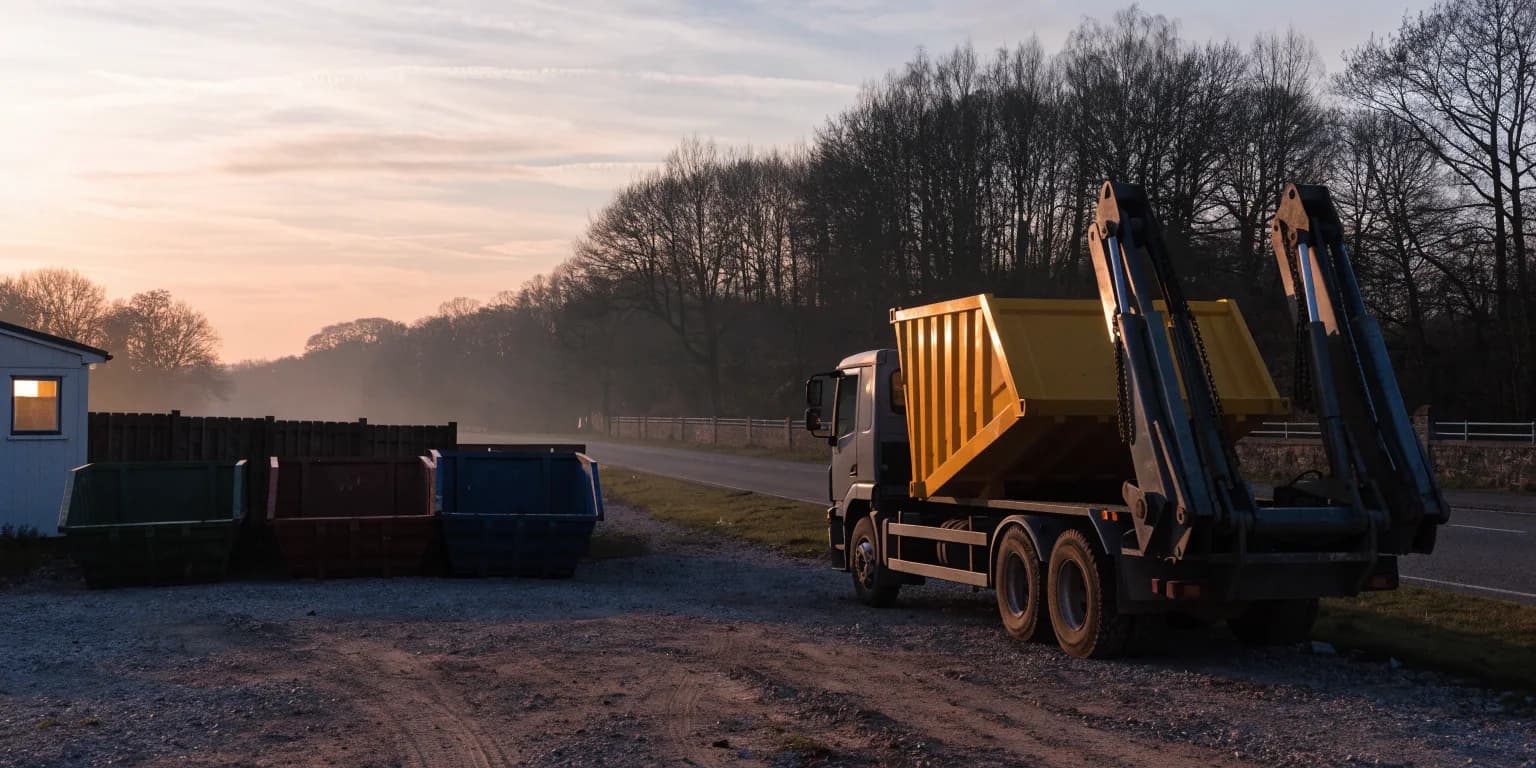
Most guides to starting a skip business are forum threads from years ago. The rules, the prices and the paperwork have all moved since, and they move again in 2027, when carrier registrations in England become permits and carriers start reporting their own loads to DEFRA. This is the current version, in the order you would actually do it, with real cost ranges so you can build a first-year budget. It is written as much for a man-and-van or grab firm adding skips as for someone starting from nothing.
What licences do you need?
Four, and the slowest one decides when you can start. Get the operator licence application in first.
1. A waste carrier registration, then a permit
Carrying other people's waste needs an upper tier registration with the Environment Agency in England. It costs £191.02 and lasts three years, with renewal at £130.25 (gov.uk). Wales, Scotland and Northern Ireland have their own regulators.
From 22 July 2027, upper tier carriers in England move onto environmental permits. Each firm switches the day after its registration would have expired, so a firm registering now still moves across at its renewal date. The permit fees have not been published yet. Our posts on the move to permits and upper or lower tier cover the detail.
2. A goods vehicle operator licence
Any vehicle over 3.5 tonnes carrying goods for hire or reward needs an operator licence, and a skip for a customer is exactly that. You need a standard national licence, not a restricted one, because a restricted licence only covers your own goods (DVSA operator licensing guide).
- Fees. £257 to apply and £401 when the licence is issued, then £401 every five years to keep it (gov.uk).
- Financial standing. You must show you have £8,000 available for the first heavy vehicle and £4,500 for each one after. This is money you hold, in the bank or as an overdraft, not a fee you pay.
- A transport manager. A standard licence needs a named person with the Transport Manager CPC, a qualification in running vehicles legally. That can be you, if you take the exams, or someone you employ or contract part time.
- Time. Apply at least nine weeks before you need the licence. Straightforward cases are usually done in that time, but it can take longer.
3. An operating centre
The operating centre is where the vehicle is kept when it is not working. It needs off-street parking for every vehicle on the licence, it goes on the licence itself, and you have to advertise it in a local newspaper so neighbours can object. A rented space at someone else's yard can work, as long as you have permission to use it.
4. The right driving licence
Most skip loaders are 18 tonne two-axle wagons, which need a category C licence, for vehicles over 3,500 kg. Smaller 7.5 tonne skip loaders, used for mini and midi skips, fall under category C1, vehicles between 3,500 and 7,500 kg (gov.uk). Anyone driving either for a living also needs Driver CPC, with 35 hours of training every five years. Driving without it can mean a fine of up to £1,000.
Buying the vehicle and the first skips
Almost everyone starts with a used skip loader. Brand new 18 tonners are sold on quotes rather than published prices, and nearly new ones show what you would be paying for: a 2023 Renault D 250 was listed on Gumtree at £44,950 in October 2026.
| What | Example listing, October 2026 | Price |
|---|---|---|
| Older 18 tonne skip loader | 2014 DAF CF 310 with extending arms, Autotrader | £8,500 plus VAT |
| Mid-age | 2019 Volvo FL 250, Autotrader | £19,500 plus VAT |
| Newer | 2022 DAF LF 230 with electric sheeting, Autotrader | £39,950 plus VAT |
| Nearly new | 2023 Renault D 250, Gumtree | £44,950 |
On an older wagon, budget for the hydraulics and the arms as well as the engine. Get the lifting gear inspected before you buy, because it will need a thorough examination under the lifting regulations once it is working anyway.
How many skips, and what they cost
| Size | New, maker's list price | Used |
|---|---|---|
| 4 yard (mini or midi) | £599.63 | Ask locally |
| 6 yard (builders) | £682.50 | Ask locally |
| 8 yard (builders) | £1,021.20 | £550 each, a batch of 14 on Gumtree |
| 12 yard | £1,595.00 |
Start with the sizes your area asks for. For most firms that is mostly 6 and 8 yard builders skips, with a few 4 yards for householders who cannot fit anything bigger on the drive. Twenty skips is a sensible first batch for one vehicle.
A rule of thumb, not a rule
Our estimate is that one skip loader can keep somewhere between 40 and 60 skips earning, depending on how long customers keep them and how far you travel. Start nearer 20 and buy more when you are regularly turning work away for want of a skip.
Do you need a yard?
Not to start. If every full skip goes straight from the customer to a transfer station, you only need somewhere to park the vehicle and stack empty skips, and that is your operating centre.
The moment you want to tip skips at your own place, sort them, or keep a full one overnight, you are storing and treating waste, and that needs permission from the Environment Agency: an exemption for small, low-risk work, a standard rules permit such as SR2022 No 5 for a transfer station, or a bespoke permit. You will also need planning permission from the council. Our guides to permits and exemptions and opening a transfer station go through it.
There is one more reason to wait. Since 1 October 2026, every permitted site that receives waste in England and Wales has to report each load to DEFRA's digital waste tracking service within two working days. Run your own permitted yard and that reporting is your job.
Your first tip account
A tip account is a credit account at a transfer station. Instead of paying at the gate for every load, you are invoiced, usually monthly. Expect the site to ask for trade references or a credit check before it gives a new firm terms, and to want cash at the gate until it does.
Gate fees are charged per tonne and depend on what is in the skip. Clean rubble and soil cost far less than mixed waste. Plasterboard, mattresses, tyres and anything hazardous are charged extra or refused. If a load is rejected, it goes back on your vehicle and you pay to take it somewhere else, so read the site's acceptance list and tell your customers what cannot go in.
Tipping is the biggest single cost on almost every skip. Part of it is landfill tax, paid on whatever the site cannot recycle: £130.75 a tonne on most waste and £8.65 on inert material from 1 April 2026. Published gate fees for mixed construction waste ran from about £160 to £250 a tonne before VAT in 2026. Our landfill tax post shows how that works through to a skip price.
Insurance
You need five kinds of cover, and insurers ask about all of them together:
- Motor for the skip loader, including the lifting gear.
- Goods in transit, for what is in the skip while you are carrying it.
- Public liability, which covers a skip on the road being hit at night. Councils set a minimum before they issue a road permit: Bristol asks for £5 million, Carmarthenshire £10 million.
- Employers' liability, a legal requirement once you employ anyone outside your family, for at least £5 million. Going without can mean a fine of £2,500 for every day (gov.uk).
- Cover for the skips themselves while they sit on customers' drives and roads.
Prices depend heavily on the driver's age and record, where the vehicle is kept and your claims history, and a new firm has none. As a rough planning range, and it is our estimate rather than a quote, allow £4,000 to £10,000 for the first year on one skip loader with all five covers. Expect to be asked how many skips you run, whether drivers are on PAYE, whether you take hazardous waste and where the vehicle is parked at night.
Pricing your first skip
Build the price up from your own costs, not down from a competitor's website. The competitor may tip somewhere cheaper, own the vehicle outright, or be losing money.
For each size and waste type, add up: the tipping cost at a realistic weight, fuel for the delivery and collection, the driver's time across both trips, wear on the skip, the office time for booking and invoicing, and a permit if it goes on the road. Then add your margin. Our worked example does this line by line for an 8 yard mixed skip and a 6 yard of rubble. Set a weight limit for each size and a charge per tonne over, or one heavy rubble job can wipe out a week.
The admin nobody warns you about
- A transfer note for every job, kept for two years. Our transfer note guide covers what goes on one.
- Council permits for road skips, applied for by you, not the customer, with an expiry date someone has to watch. See skip permits explained.
- Chasing payment. Builders on 30 days often pay in 60. Your tip account does not wait.
- Knowing which skip is where, and how long it has been there. Twenty skips is easy to remember. Sixty is not. See tracking skips without GPS.
- A walkaround check before the vehicle goes out each day, written down. Our walkaround check guide has the list.
For the first month a diary, a whiteboard and a book of transfer notes are fine. It gets hard when the second vehicle arrives, or when the office person is also the driver. LoadSnap keeps the job, the transfer note, the customer's signature and the road permit date together, and the free plan covers your first 10 loads a month. The pricing page shows what each plan includes.
A first-year start-up budget
Here is what one vehicle and twenty skips cost to get on the road, from the figures above. The financial standing money is not spent, but it has to be there, so it sits outside the total.
| Item | Low | High | Where the figure comes from |
|---|---|---|---|
| Operator licence fees | £658 | £658 | £257 application plus £401 issue, gov.uk |
| Upper tier carrier registration | £191 | £191 | gov.uk, England |
| Used 18 tonne skip loader | £8,500 | £45,000 | Listings, October 2026 |
| Twenty 8 yard skips | £11,000 | £20,424 | £550 used to £1,021.20 new each |
| Insurance, first year | £4,000 | £10,000 | Our estimate, get quotes |
| Signwriting, skip paint and markings | £500 | £2,000 | Our estimate |
| First month's tipping | £4,800 | £15,000 | 20 to 40 skips of 1.5 tonnes at £160 to £250 a tonne |
| Total cash out | £29,649 | £93,273 | |
| Financial standing held in the bank | £8,000 | £8,000 | First heavy vehicle, DVSA |
The tipping line matters most for cash flow. You pay the tip on its terms, often before your customers have paid you.
Questions people ask
How much does it cost to start a skip hire business?
From about £30,000 with an older used vehicle and second-hand skips, to over £90,000 with a nearly new vehicle and new skips, plus £8,000 held in the bank for the operator licence. Most first-time firms land somewhere in the lower half.
Are skip hire businesses profitable?
They can be, but the margin is made or lost in two places: what you pay to tip, and how many days each skip spends earning rather than sitting in the yard. A firm that knows its tipping cost per tonne and keeps its skips out on hire does well. One that copies a rival's prices and leaves skips on site for weeks unbilled does not.
What licence do you need to drive a skip wagon?
Category C for a typical 18 tonne skip loader, or C1 for a 7.5 tonne one, plus Driver CPC for anyone driving it for work.
Start with the paperwork sorted
Run your first 10 jobs a month on LoadSnap for free, transfer notes and signatures included. See the plans.
LoadSnap team
Running a waste business
Written by the team building LoadSnap, the UK waste compliance platform for carriers and receivers.
Keep reading
Do you need to report the waste you receive? DEFRA's guidance, read from the weighbridge
Oct 8, 2026 · 8 min
Upper tier or lower tier: which waste carrier licence you need and what it costs
Oct 4, 2026 · 5 min

Season tickets: when one transfer note can cover a year
Oct 4, 2026 · 5 min
Digital waste tracking is live
The mandate is here.
Automate compliance.
Receiving sites in England and Wales have had to record every load digitally since 1 October 2026. Start a 14-day free trial in minutes, cancel any time before it ends, and file every load from day one.
DEFRA API integrated · EA carrier verification · UK data residency