Opening a waste transfer station: exemption, standard rules or bespoke permit
The three ways to run a yard that takes in waste: a registered exemption, a standard rules permit or a bespoke permit. What each allows, what it costs, how long it takes, and the planning and competence steps people forget.

LoadSnap team
Running a waste business
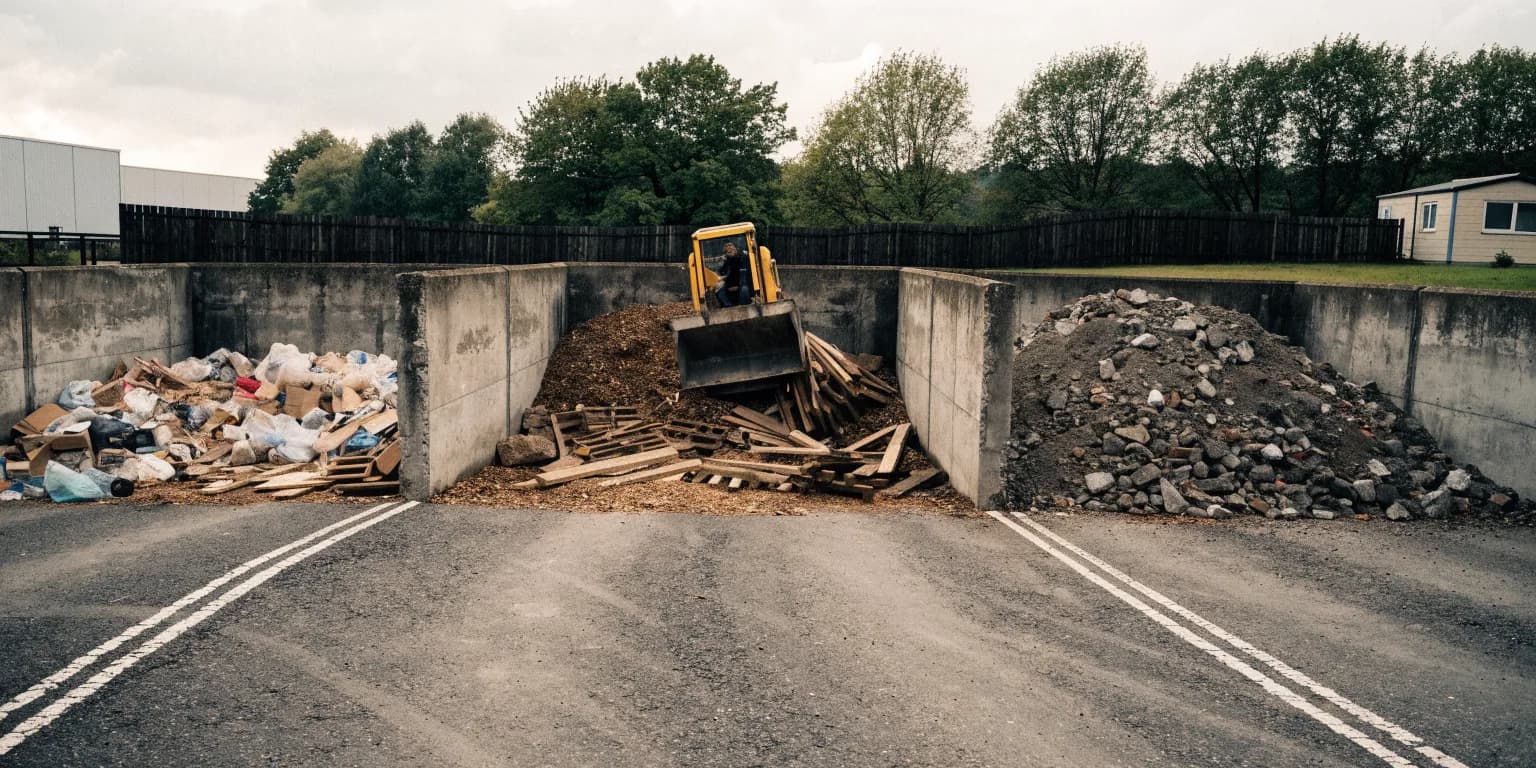
Sooner or later most skip firms want their own yard: somewhere to tip, sort and bulk up instead of paying someone else's gate fee. There are three legal routes, and choosing the wrong one costs months. This compares them side by side, covers the planning and competence steps people forget, and explains why, since 1 October 2026, opening a permitted yard also makes you a receiving site for DEFRA reporting. It covers England.
The three routes at a glance
Anyone keeping, sorting or treating other people's waste needs permission from the Environment Agency. For a yard, it comes in three kinds. Our post on waste permits and exemptions explains the codes in more detail.
| Exemption | Standard rules permit | Bespoke permit | |
|---|---|---|---|
| What you can do | Store or prepare single, separated types of waste. No mixed waste. | A fixed rule set, such as a transfer station that bulks and hand-sorts mixed waste | Whatever the permit is written to allow, including treatment |
| How much | Small, fixed limits for each exemption and waste | Set by the rule set, such as under 75,000 tonnes a year | Set in your own permit |
| Cost to get | £58.13 a site plus £435.96 for each band 1 exemption | From £2,741.36 to £4,075.19 for the rule sets a skip yard uses | £9,524.69 for a household, commercial and industrial transfer station, plus consultant fees |
| Yearly cost | None, but you pay again every three years | From £2,271.97 to £3,402.05 | From £2,271.97, rising with tonnage and treatment |
| Time to get | Register online | Usually decided within four months | Usually decided within four months of a complete application, after months of preparation |
Waste exemptions
An exemption is a registration for small, low-risk waste work that does not need a permit. It lasts three years. Since 1 July 2025 it is no longer free in England: there is a registration charge of £58.13 for each site, plus a charge for each exemption, which for band 1 exemptions such as T4 and S2 is £435.96 (gov.uk charges).
The two a would-be yard looks at are T4, for sorting, baling and similar preparation, and S2, for storing waste at a secure site before it goes on for recovery. Both are written for clean, separated streams. Under T4, different types of waste have to arrive separately and be kept apart. Under S2 you cannot store mixed waste at all, and the limits are tight: 100 tonnes of construction and demolition waste, for up to twelve months.
That is why most skip yards outgrow exemptions on day one. A skip comes back mixed, and tipping, sorting and bulking mixed waste is a transfer station, which the Environment Agency only allows under a standard rules or bespoke permit (gov.uk). An exemption can suit a firm that only stores one clean stream, such as separated scrap metal or crushed concrete, but not a general skip yard.
More change is coming. DEFRA has announced it will scrap some exemptions, tighten the limits on others including T4 and S2, and stop exemptions being used on or next to permitted sites. Start dates have not been confirmed yet, which is another reason not to build a business on one.
Standard rules permits
A standard rules permit is an off-the-shelf permit with fixed rules. If your site can meet every rule in the set, you apply for it as it stands. It is quicker and cheaper than a bespoke permit, but you cannot change the rules or appeal against them.
Three rule sets cover most skip yards in England:
| Rule set | What it allows | Limit | Application | Yearly |
|---|---|---|---|---|
| SR2022 No 5 | Household, commercial and industrial transfer station. Bulking and sorting by hand, plus storing asbestos, hazardous batteries, cable and electrical waste. | Under 75,000 tonnes a year | £4,075.19 | £3,402.05 |
| SR2022 No 4 | As No 5, plus screening, crushing, shredding, baling and compacting | Under 75,000 tonnes a year | £4,075.19 | £4,933.26 |
| SR2022 No 3 | Construction, demolition and excavation waste transfer station, no screening or crushing | Under 250,000 tonnes a year | £2,741.36 | £2,271.97 |
SR2022 No 5 replaced the old SR2008 No 1 in England, so older guides that quote SR2008 No 1 are out of date here. Its rules set out where and how you can operate (gov.uk, SR2022 No 5):
- Not within 500 metres of a European site, Ramsar site, SSSI or Marine Conservation Zone, and not in a groundwater Source Protection Zone 1.
- Wastes stored outside kept at least 10 metres from a watercourse and 50 metres from nature reserves, ancient woodland and scheduled monuments.
- The main waste types stored and handled on an impermeable surface with sealed drainage.
- Treatment limited to bulking up, sorting by hand and separating.
- Nothing stored for longer than six months, and a fire prevention plan, which is assessed as part of the application.
Check the distances against a map before you sign a lease, not after.
Bespoke permits
You need a bespoke permit when your site cannot meet a standard rule set, perhaps because it is too close to a river or a protected site, or when you want to do more: mechanical treatment beyond the rule sets, more tonnage, or wastes the rules do not list.
A bespoke permit is written for your site, backed by your own risk assessments, and it costs more. The application for a household, commercial and industrial transfer station is £9,524.69, and extra plans and assessments can add to it. Most firms pay a consultant to write the application, which can take months before it is even submitted. The Environment Agency offers free basic advice before you apply, and more detailed advice at £103.80 an hour plus VAT (gov.uk). On a bespoke application it is usually money well spent.
Planning permission is a separate question
A permit does not give you planning permission, and planning permission does not give you a permit. They are decided by different bodies: the permit by the Environment Agency, and planning by the waste planning authority, which is usually the county or unitary council.
Apply for both in parallel. For some waste sites the Environment Agency will only issue the permit once planning permission is in place, so a permit application sent in alone can sit waiting (Environment Agency guidance). Ask the council early whether the land already has a waste use, because a yard that was a builder's merchant is not automatically allowed to become a transfer station.
Technical competence and the person in charge
A permitted waste site has to be run by someone who is technically competent. There are two approved ways to show it: the CIWM (WAMITAB) operator competence scheme, where a named manager holds the qualification and passes a continuing competence assessment every two years, and the Energy and Utility Skills scheme, run with the Environmental Services Association, which certifies the business as a whole (gov.uk).
For a new permit that is not a landfill, you have up to twelve months to get this in place. On a standard rules site, the competent manager must attend for at least 20% of operating hours for the first six months. The Environment Agency also looks at relevant convictions and whether you can afford to run the site properly.
A simple yard plan helps everyone, from the council to the insurer:
- A weighbridge at the gate, so every load in and out has a weight.
- A tipping area on an impermeable surface with sealed drainage.
- Bays for each sorted stream: wood, metal, hardcore, cardboard, residual.
- A separate, covered area for asbestos and batteries if your permit allows them.
- Fire breaks and stack sizes that match your fire prevention plan.
From October 2026 you are a receiving site
Since 1 October 2026, every permitted site in England and Wales that receives waste has to report each load to DEFRA's digital waste tracking service, by the end of the second working day after it arrives. Open a permitted yard and that duty is yours from your first load. You will need a DEFRA tracking code before you start.
Sites running only on exemptions are not in this first phase. DEFRA says exemptions will be included in a later phase, with no date yet.
LoadSnap records each load at the gate, files it to DEFRA, and keeps a running total against your permit's annual tonnage and storage limits. The receiving sites page shows how, and the digital waste tracking guide has the full timeline.
Wales and Scotland
Wales uses the same law, run by Natural Resources Wales, but kept the older standard rules codes such as SR2008 No 1, and registering most exemptions there is still free. Scotland moved to a new system run by SEPA on 1 November 2025, with general binding rules, registrations and permits, so the routes above do not apply as written.
Questions people ask
Do I need a permit for a waste transfer station?
Almost always. The Environment Agency lists a waste transfer station only under standard rules and bespoke permits. An exemption only covers storing or preparing separated waste within small limits.
How long does a standard rules permit take?
The Environment Agency usually decides a new permit application within four months. Add time for planning, finding a site that meets the distance rules and writing your fire prevention plan.
See who is already near you
See every permitted site of each type near you, and what it is allowed to take, in the free LoadSnap waste directory.
LoadSnap team
Running a waste business
Written by the team building LoadSnap, the UK waste compliance platform for carriers and receivers.
Keep reading
Do you need to report the waste you receive? DEFRA's guidance, read from the weighbridge
Oct 8, 2026 · 8 min
Upper tier or lower tier: which waste carrier licence you need and what it costs
Oct 4, 2026 · 5 min

Season tickets: when one transfer note can cover a year
Oct 4, 2026 · 5 min
Digital waste tracking is live
The mandate is here.
Automate compliance.
Receiving sites in England and Wales have had to record every load digitally since 1 October 2026. Start a 14-day free trial in minutes, cancel any time before it ends, and file every load from day one.
DEFRA API integrated · EA carrier verification · UK data residency