Waste permits and exemptions explained: what the codes mean
Standard rules, bespoke, exemption: what each kind of waste permission means, how to read codes like SR2022 No 5, U1, T4, S2 and D7, and what to check before you tip at a site.

LoadSnap team
UK waste compliance
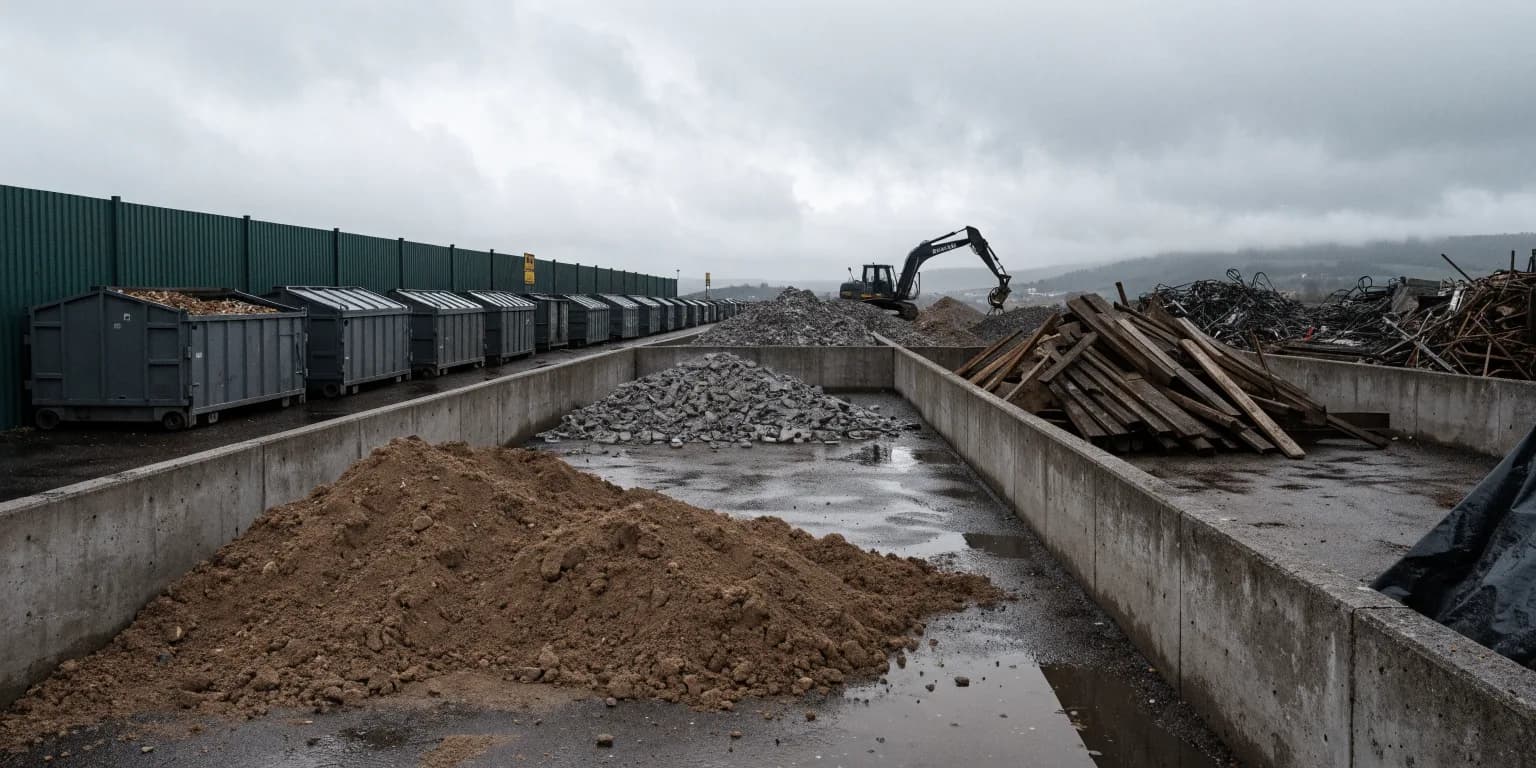
Look a waste site up on the public register, or in our directory, and you will see words like standard rules, bespoke or exemption, and codes like SR2022 No 5, U1 or T4. They tell you what the site is allowed to take in and what it may do with it. This post explains every kind, in England, in the order you are most likely to meet them.
The three kinds at a glance
Anyone keeping, treating or getting rid of waste in England needs permission from the Environment Agency. It comes in three kinds:
| Kind | What it is | Typical holder |
|---|---|---|
| Waste exemption | A registration for small, low-risk work, with tight limits on how much and how long | A farm burning hedge cuttings, a builder reusing crushed brick on a track |
| Standard rules permit | A permit with a fixed set of rules written for a common activity | A skip firm's own transfer station |
| Bespoke permit | A permit written for one site, with its own conditions | Large transfer stations, landfills, treatment plants |
Standard rules permits
A standard rules permit is, in the Environment Agency's words, a set of fixed rules for common activities. If a site can meet every rule in the set, it applies for that set as it stands. It is quicker and cheaper to get than a bespoke permit, but the operator cannot change the rules or appeal against them (gov.uk).
How to read the code
The code is SR, for standard rules, then the year of the series, then the number of the rule set within it. So SR2022 No 5 is rule set number 5 in the 2022 series. The year is the series rather than the date the rules came out: the 2022 sets were published in December 2024.
Old codes on the register
In December 2024 the Environment Agency folded 28 older waste rule sets in England into 8 new ones, and sites had until June 2025 to move across. So a site that used to show SR2008 No 1, the old 75,000 tonne transfer station rules, should now show SR2022 No 5. If you still see an old code on a site in England, it is worth asking why. Wales kept the old codes.
The rule sets a skip or haulage firm meets most
| Code | What the site does | Limit |
|---|---|---|
| SR2022 No 5 | Non-hazardous waste transfer station, which can also store asbestos, hazardous batteries, cable and electrical waste. Bulking and sorting by hand only. | Under 75,000 tonnes a year |
| SR2022 No 4 | Non-hazardous waste recycling: a transfer station that also screens, crushes, shreds, bales and compacts | Under 75,000 tonnes a year |
| SR2022 No 3 | Construction, demolition and excavation waste transfer station, with no screening or crushing | Under 250,000 tonnes a year |
| SR2022 No 7 | Materials recycling facility | Under 75,000 tonnes a year |
| SR2022 No 1 | Treating waste to make soil, soil substitutes and aggregate | Under 250,000 tonnes a year, no more than 75,000 of it other than soil |
| SR2022 No 2 | The same treatment with mobile plant, moved from site to site | Each site needs its own deployment |
| SR2021 No 12 | Storing, depollution and dismantling of end-of-life vehicles | Under 750 tonnes of vehicles a year |
Why this matters when you are tipping: the rule set limits what the site may accept. A site on SR2022 No 3 takes construction and demolition waste, not a skip of mixed household clear-out. The code on the register tells you, before you set off, whether your load is allowed in.
Bespoke permits
A bespoke permit is the one a site needs when its work does not fit any standard rule set: it is bigger, riskier, or does something unusual. It is written for that site, backed by the operator's own risk assessments, and it takes longer and costs more to get.
For a carrier, the important difference is that a bespoke site's list of accepted waste is in its own permit, not in a published rule set. The label "bespoke" tells you nothing about what goes in. Ask the site, or read the permit on the register.
Waste exemptions and their four letters
An exemption is for small, low-risk work that does not need a permit. It is a registration, not a permit, and it lasts three years. Each exemption has a letter for the kind of activity and a number:
- U is for using waste. U1 is using suitable waste in construction, such as crushed brick and concrete for a farm track or a yard base. Up to 1,000 or 5,000 tonnes over three years, depending on the waste, and more for road building.
- T is for treating waste. T4 covers sorting, baling, shredding and similar preparation before the waste goes on for recycling, with limits that depend on the waste.
- D is for disposing of waste. D7 is burning plant and untreated wood waste where it was produced, such as hedge cuttings on a farm. Up to 10 tonnes in any 24 hours.
- S is for storing waste. S2 is storing waste at a secure site before it goes somewhere else to be recovered, for between three and twelve months depending on the waste.
Go over an exemption's limits, or take in waste it does not cover, and the activity needs a permit. A carrier who tips more at an exempt site than its exemption allows is part of the problem, so it is worth knowing which exemption a small site is relying on.
Exemptions are no longer free
Since 1 July 2025, registering waste exemptions in England costs money: a registration charge of £58.13 for each site, plus a charge for each exemption that depends on its band, from £31.14 up to £1,282.97. U1, S2 and T4 are in band 1 at £435.96 each. Charities pay nothing (gov.uk charges). Many older guides still say exemptions are free, which is no longer true in England.
More change is coming. DEFRA has announced it will scrap some exemptions, tighten the limits on others including U1, S2, T4 and D7, and stop exemptions being used on or next to permitted sites. Start dates have not been confirmed yet.
Other labels you may see
- Non-waste framework directive exemptions, often shortened to NWFD. These cover keeping waste for a short time where it was produced. There is nothing to register, but the conditions still apply.
- Low risk waste positions. These are statements from the Environment Agency that it will not insist on a permit for certain very low-risk activities. They are the regulator's stance, not the law, and can be withdrawn with three months' notice.
What to check before you tip
- 01That the site has a permit or a registered exemption at all. Search the Environment Agency's permit register and exemptions register, which are separate searches.
- 02That it covers your load. For a standard rules site, the rule set tells you. For a bespoke site, the permit does. For an exempt site, the exemption's own conditions do.
- 03That the permit or exemption number goes on your transfer note. It is one of the boxes an officer looks for.
Wales and Scotland
Wales uses the same law, run by Natural Resources Wales, but kept the older standard rules codes such as SR2008 No 1, and registering most exemptions there is still free. Scotland moved to a new system on 1 November 2025, run by SEPA, with general binding rules, registrations and permits. Waste exemptions there cannot be renewed, and anyone relying on one needs a new authorisation by 1 November 2026 or when the exemption runs out, whichever comes first.
Questions people ask
What is a U1 exemption?
Registration to use suitable waste, such as crushed brick, concrete or soil, in construction work, within set tonnage limits over three years. It costs £58.13 per site plus £435.96 for the exemption.
What does SR2008 No 1 mean?
The old standard rules for a household, commercial and industrial waste transfer station taking under 75,000 tonnes a year. In England it has been replaced by SR2022 No 5. Wales still uses it.
How long does a waste exemption last?
Three years, then it has to be renewed, and paid for again.
Is a waste exemption the same as a carrier licence?
No. Exemptions and permits cover what happens to waste at a place. A carrier registration covers moving it on the road. See our guide to checking a carrier licence.
Look a site up
Search permitted sites and the companies behind them on one map in the LoadSnap waste directory, free.
LoadSnap team
UK waste compliance
Written by the team building LoadSnap, the UK waste compliance platform for carriers and receivers.
Keep reading
Do you need to report the waste you receive? DEFRA's guidance, read from the weighbridge
Oct 8, 2026 · 8 min
Upper tier or lower tier: which waste carrier licence you need and what it costs
Oct 4, 2026 · 5 min
Season tickets: when one transfer note can cover a year
Oct 4, 2026 · 5 min
Digital waste tracking is live
The mandate is here.
Automate compliance.
Receiving sites in England and Wales have had to record every load digitally since 1 October 2026. Start a 14-day free trial in minutes, cancel any time before it ends, and file every load from day one.
DEFRA API integrated · EA carrier verification · UK data residency