Waste transfer notes: the complete guide for carriers
What goes on a waste transfer note, who signs it, how long to keep it, and what digital waste tracking changes. Written for skip firms and carriers, read the way an Environment Agency officer would read your notes.

LoadSnap team
UK waste compliance
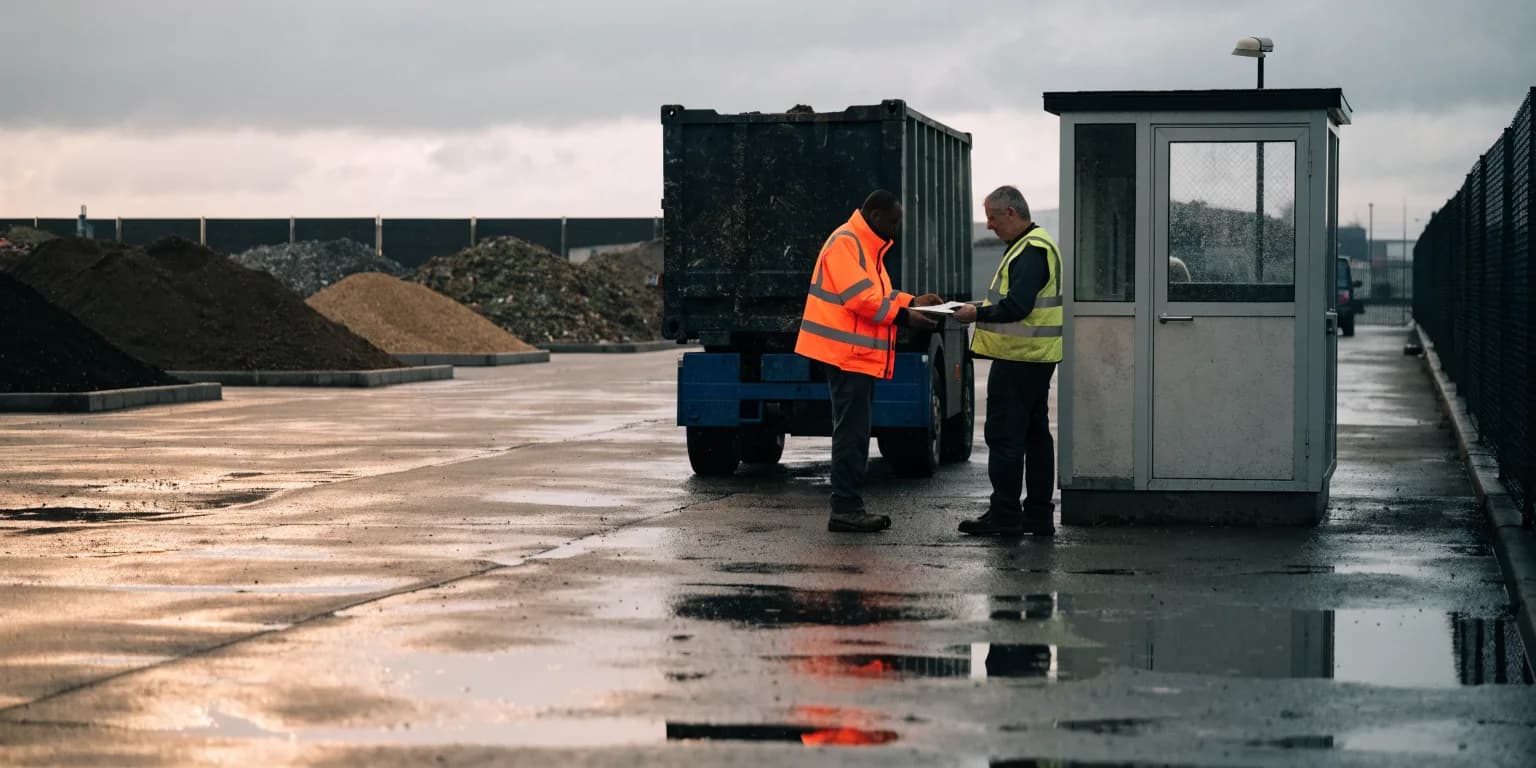
Every load you move needs a piece of paper behind it, and most firms fill it in from habit rather than from the rules. This guide goes through the waste transfer note the way an Environment Agency officer would read it: what has to be on it, who is responsible for each part, and the mistakes that come up in checks. By the end you will know whether your own notes would pass.
What is a waste transfer note?
It is the written record of waste passing from one person to another. You need one every time non-hazardous business waste changes hands: from the customer to the skip firm, and from the skip firm to the tip.
The requirement comes from the duty of care in section 34 of the Environmental Protection Act 1990. What the note must contain is set out in regulation 35 of the Waste (England and Wales) Regulations 2011, and explained in the government's duty of care code of practice. Scotland and Northern Ireland have their own rules built on the same idea.
It is worth being clear what a transfer note is not. It is not your carrier registration, not a weighbridge ticket and not a DEFRA record, although since October 2026 the tip copies details off it into one. Hazardous waste does not travel on a transfer note at all. It needs a consignment note instead.
Who fills it in, and who signs it?
Both sides of every handover sign: the person handing the waste over, called the transferor, and the person taking it, called the transferee. On a skip job that is usually the customer and the skip firm. At the tip it is the skip firm and the site.
In practice the carrier nearly always writes it. That is fine, but it also means the carrier carries most of the risk when it is wrong, because the customer will say they signed what your driver put in front of them.
Take a kitchen refit. The builder ripping out the old kitchen produces the waste. The skip firm carries it. The transfer station receives it. So there are two notes: builder to skip firm when the skip is collected, and skip firm to transfer station at the gate. If the homeowner hires the skip directly for the builder's waste, the builder is still the producer, and the note should say so.
A typed name is not a signature
On paper, a signature is a person's own mark. On a phone it is the person drawing it themselves on the screen. A name typed into a box by the driver, on the customer's behalf, does not show the customer agreed to anything.
What should be on a waste transfer note?
Everything an officer would need to follow the waste from one person to the next. The full list:
- A written description of the waste, and its EWC code.
- How much there is, and how it is held: loose, in a skip, in bags, and what kind of container.
- The date, time and place of the transfer.
- The names and addresses of both parties.
- The transferor's SIC code, the code for what their business does.
- The role each party is acting in: producer, carrier, broker, dealer, permit holder and so on.
- The carrier's registration number, and the permit or exemption number for a site.
- Confirmation that the transferor has applied the waste hierarchy, in England and Wales.
- Both signatures.
Three of those go missing more than the rest:
- The SIC code. It tells the regulator what kind of business produced the waste. Without it, nobody can check the waste description makes sense.
- The hierarchy box. It is a tick box confirming the customer considered reducing, reusing and recycling before throwing away. It is a legal requirement in England and Wales, and the easiest one to forget.
- The carrier number. It is how anyone checks you were allowed to carry the load. If it is not on the note, the note proves nothing about you.
You can make a complete note for free with our transfer note generator, or download a blank template in English or Welsh.
How long do you keep them?
At least two years. Both parties keep their own copy, not just the carrier, and you must be able to produce it within seven days if the Environment Agency or the council asks. Hazardous consignment notes are different: the producer keeps them for three years and the carrier for one.
Electronic copies count. What matters is that you can find a particular note quickly when asked, which is harder with a box of carbon books in the back office than people expect.
Do waste transfer notes have to be digital?
No. Paper, a PDF and an app are all legal today.
What did change, on 1 October 2026, is that every permitted waste site in England and Wales now reports each load it receives to DEFRA's digital waste tracking service, within two working days. The site takes the details for that record from your note: the code, the description, your registration number and the weight. Carriers are due to start reporting their own loads in October 2027.
So the practical point is this: a note that is legible, complete and easy for the tip to read gets your driver through the gate faster. A smudged carbon copy with no code on it gets your office a phone call. Our post on what the October change means for carriers goes into this in more detail.
Season tickets for repeat collections
If you collect the same non-hazardous waste from the same customer again and again, one note called a season ticket can cover the lot for up to a year. The bins behind a shop emptied every Tuesday are the classic example.
A season ticket stops being valid the moment something it describes changes: a different kind of waste, a different collection address, a different carrier or a different site. Most firms do not notice when that happens, and keep using a note that no longer covers the collections.
Five mistakes that show up in a check
- 01The wrong EWC code. The usual one is 20 03 01, mixed municipal waste, on a builders' skip. That code is for household and similar general rubbish. A skip of construction waste needs a code from chapter 17. Our EWC code finder helps you find the right one.
- 02No SIC code, or the wrong one. It should be the customer's code, describing their business, not the skip firm's own.
- 03A note signed only by the driver. One signature is half a note. Both parties sign.
- 04A season ticket still in use after the waste changed. The shop that started putting out cardboard separately needs a new note for the cardboard.
- 05No way of finding last March's note. If you cannot produce it within seven days, as far as the regulator is concerned it does not exist.
Paper, PDF or app
Paper costs little and works anywhere, including on a site with no signal. Its weaknesses are handwriting, carbon copies that fade, and the time it takes to find one note in a year's worth of books.
An app saves office time and makes every note searchable, and the tip can read it without squinting. The cost is a subscription and getting drivers used to it. In LoadSnap the driver fills in the note on the job and it goes into the archive with the job. Transfer notes and the archive come with every plan, the free one too, and so does the customer signing on the driver's phone.
Questions people ask
Is a waste transfer note a legal requirement?
Yes. Every transfer of non-hazardous business waste needs one, or needs to be covered by a season ticket.
Do householders need one?
No, but householders do have a duty to give their waste only to someone registered to take it. In England a council can fine a householder who does not check, so a homeowner asking for your registration number is doing the right thing. Our guide to checking a carrier licence shows them how.
Can I make my own transfer note?
Yes. There is no official form. Any format works, paper or digital, as long as it carries everything listed above.
What about Scotland and Northern Ireland?
Scotland has the Environmental Protection (Duty of Care) (Scotland) Regulations 2014, which ask for much the same information but not the waste hierarchy declaration. Northern Ireland has its own duty of care regulations from 2013. NetRegs covers both.
Make your next note now
Fill in a complete transfer note for free with the transfer note generator, then check the carrier on it with our guide to checking a waste carrier licence.
LoadSnap team
UK waste compliance
Written by the team building LoadSnap, the UK waste compliance platform for carriers and receivers.
Keep reading
Do you need to report the waste you receive? DEFRA's guidance, read from the weighbridge
Oct 8, 2026 · 8 min
Upper tier or lower tier: which waste carrier licence you need and what it costs
Oct 4, 2026 · 5 min
Season tickets: when one transfer note can cover a year
Oct 4, 2026 · 5 min
Digital waste tracking is live
The mandate is here.
Automate compliance.
Receiving sites in England and Wales have had to record every load digitally since 1 October 2026. Start a 14-day free trial in minutes, cancel any time before it ends, and file every load from day one.
DEFRA API integrated · EA carrier verification · UK data residency