’s weighbridge book.
Replaced.
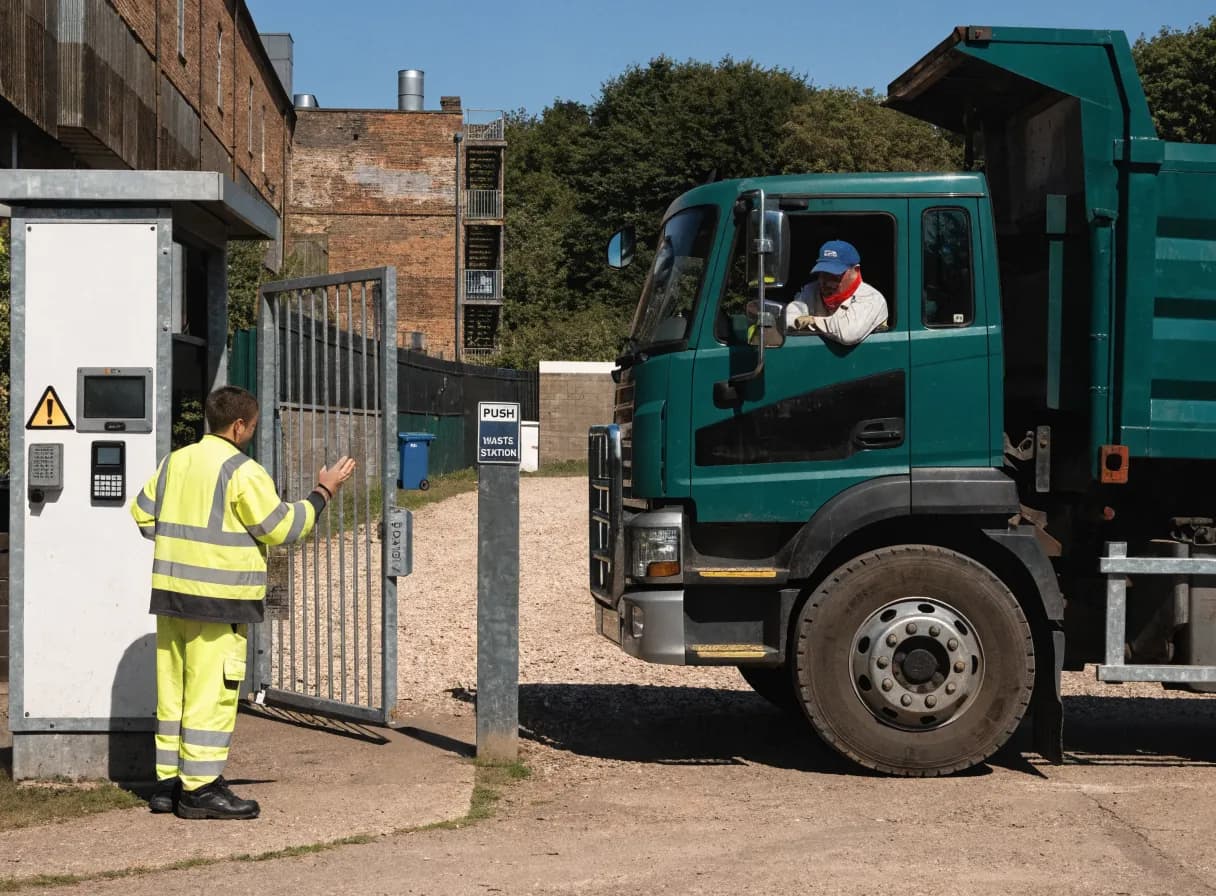
Waste receivers of every kind - transfer stations, MRFs, EfW plants, treatment sites, scrap yards and metal recycling sites. Receipts in 60 seconds, consignee returns generated automatically, and every load arriving with its WTN already digital. Built around the gate, not bolted on after.
60 sec
Gate to receipt
From axle on to ticket out
850+
EWC codes built in
Hazardous + non-hazardous
100%
Consignee returns
Auto-generated, auto-filed
0
Re-keying
Carriers' WTNs flow straight in
How it works
How it works for receivers
This is live today. DEFRA takes waste tracking submissions from receiving sites, mandatory from 1 October 2026 in England and Wales and from January 2027 in Scotland and Northern Ireland. Filing is on every plan including the free one.
The lorry arrives
Three ways to start: key it in, scan the driver's LoadSnap code, or enter a DEFRA tracking ID
Who brought it
Carrier, vehicle and driver from your own library, with the carrier's registration checked against the Environment Agency register as you pick them
What is on it
Photograph the load and the code comes back; sealed loads are keyed in from the consignment note
Weigh it
Gross and tare at the bridge and LoadSnap nets it, with the container type and how many
The office checks it
The operative sends it up and the office confirms the codes, the disposal or recovery code and the compliance fields
File it with DEFRA
One button. A waste tracking ID comes back and sits on the record
DEFRA digital waste tracking
Why the rollout runs backwards - and what it means for you
DEFRA is mandating the receiving side before the carrying side. LoadSnap is built for both phases, so you're ready whichever side of the gate you're on.
Receivers go digital while the carrier side is still on paper
DEFRA has started with the people who receive waste, not the people who carry it. So for now the carrier still turns up with a paper transfer note, and the receiving site is the one that records the movement digitally and files it to DEFRA.
- Carrier arrives; the weighbridge operative selects them from the saved carrier library and adds the vehicle reg and driver
- Each waste item captured - a photo where the load's visible (LoadSnap's AI suggests the EWC code and description), manual entry for sealed containers; the operative can edit either way
- Container type, count and weight (estimated or actual) captured at the bridge
- Operative submits to the back office, who review and file the movement to DEFRA - a Waste Tracking ID comes back
The people moving and arranging the waste join in
Phase two brings in what DEFRA calls waste collectors: carriers, brokers and dealers. The regulations have not been made and the technical detail has not been published, so what any of them will actually have to record is not yet known. What is known is the timetable.
- A private beta for invited collectors from autumn 2026
- A public beta open to all collectors from spring 2027
- Mandatory for collectors from October 2027, on DEFRA's published plan rather than in law
- Nothing a carrier or broker can file today, and nothing LoadSnap or anyone else can file on their behalf
LoadSnap digitises the whole workflow and produces your WTNs and records on both sides today. DEFRA submission is live for receiving sites now, and switches on for carriers when their phase starts.
Beyond compliance
More than just compliance
Your drivers have a portal. Your vehicles are tracked. Your data connects to your accounting.
Vehicle checks
Daily pre-use checks with photo issue reporting, odometer tracking, MOT and tax alerts
Driver management
Full profiles. Licence expiry. Training records. Smart assignment matching qualifications to job requirements.
Job scheduling
List, calendar, and map views. Assign drivers and vehicles. One-tap navigation via Google Maps or Waze.
Driver map
See where drivers last completed a job. Timestamps and job locations with the day's route.
Expense + fuel logging
Drivers photograph receipts. AI reads amount, merchant, litres. Admin approves. CSV export.
Fuel finder
Live fuel prices at every UK station, filtered by fuel type. Powered by FuelChecker.
Route planning
Jobs on a map with optimised stop order. Turn-by-turn via Google Maps or Waze. No app.
Digital signatures
Customer signs on the driver's phone. Signature embedded on the Waste Transfer Note PDF.
The receiver workflow
Every gate, every weighbridge, every consignee return.
Operatives, supervisors, and your compliance lead all on the same system - with the regulator API on the other end of it.
Works with any weighbridge
Read gross and tare off your existing bridge and key them in; LoadSnap works out the net and files the record. No hardware integration, no install.
AI on the arriving load
Photo + carrier ticket → EWC code confirmed, hazardous flagged. Operative just confirms.
QR / NFC scan
Driver shows the carrier's QR. Site, customer, EWC and WTN are already on screen. Hit weigh, hit print.
Consignee returns
Filed quarterly with DEFRA without lifting a finger. Period totals, per-EWC tonnage, the lot.
Permit limits
Annual tonnage limits monitored continuously - alerts at 70% / 85% / 95%, hard-stop options at 100%.
Hazardous handling
HWCN-aware. Premises codes, H-codes, sign-off chain. Storage and onward routing fully tracked.
Receiver-side superpower
Loads arrive already digital.
When a LoadSnap carrier pulls onto your weighbridge, their WTN, customer, EWC and signature are already in your system. You read the bridge, key in the weight, capture the photo, and the receipt prints itself.
QR / NFC scan at the gate
No more handing tickets through cab windows. Driver shows the code, the load is on the screen.
Photo evidence captured
Top-down of the load against the weighbridge timestamp. Defensible in an audit, indispensable in a dispute.
Operative-only mode
Lock the tablet to the receive flow only. No menus, no inbox, no risk of someone hitting the wrong thing.
Gross
31.20 t
Tare
12.74 t
Net
18.46 t
Carrier
M&J Skips
Built for UK receivers
The October 2026 mandate, handled.
Day-one DEFRA submission
Receiver filing has been mandatory since 1 October 2026. We were in the DWT Beta from the start.
Multi-site permissions
One company, many gates. Per-site settings, per-user roles, consolidated returns.
Documents archive
Every WTN, HWCN, consignee return, photo and signature kept for the statutory 3 years, searchable.
Environmental reports
Tonnage by EWC, recovery rates, R/D code reporting. Bake your DEFRA returns out as a PDF.
Questions
Receiver questions, answered.
01Who is LoadSnap for on the receiving side?
02Do you integrate with our weighbridge or scales?
03Is DEFRA submission included?
04When does the receiver requirement apply?
05Does it generate consignee returns?
Digital waste tracking is live
The mandate is here.
Automate compliance.
Receiving sites in England and Wales have had to record every load digitally since 1 October 2026. Start a 14-day free trial in minutes, cancel any time before it ends, and file every load from day one.
DEFRA API integrated · EA carrier verification · UK data residency