Digital waste tracking: the mandate,
explained for .
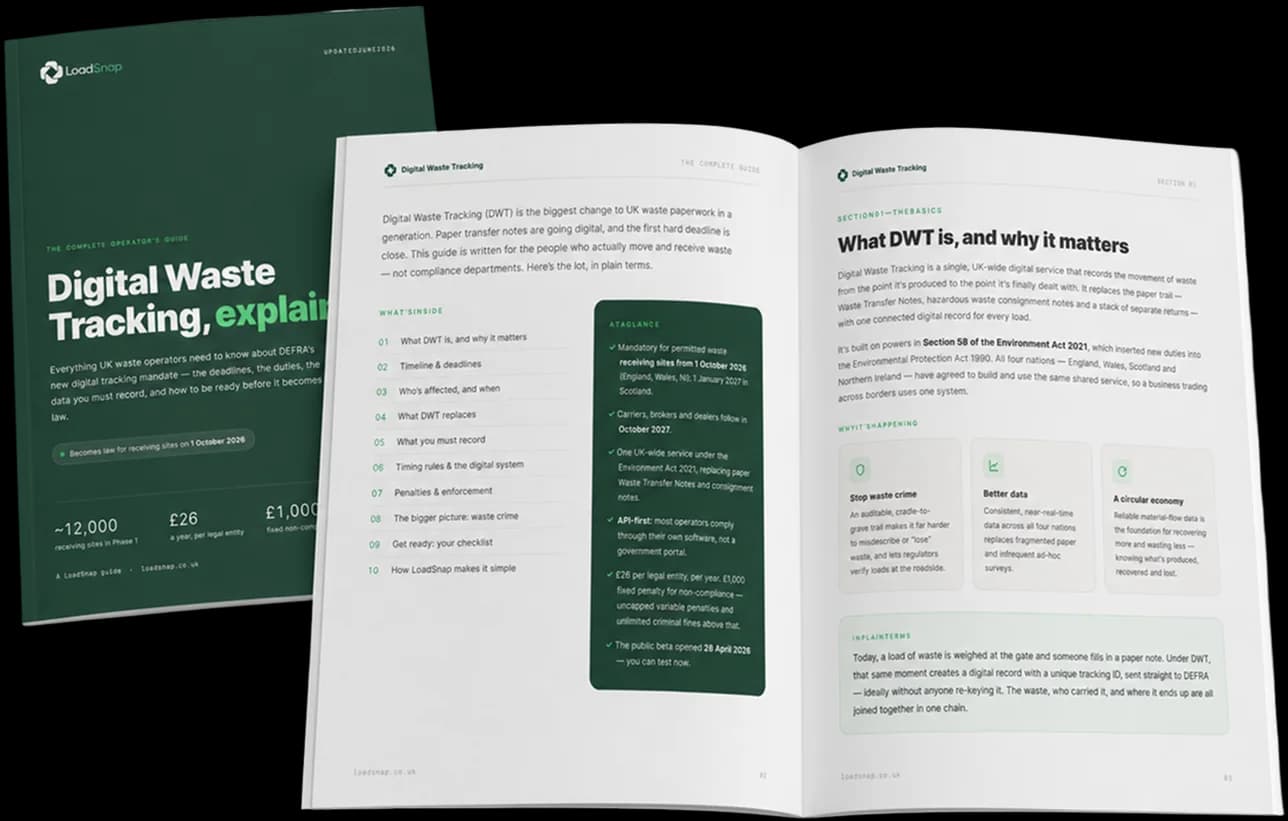
Paper waste transfer notes are being replaced by DEFRA's digital waste tracking service. What changes, when it is mandatory in each nation, and how to be ready without panicking - all in a free 20-page guide, with a route through it for your kind of business.
No spam. We'll send the PDF and a single follow-up. That's it. We may use the details you enter to follow up, even if you don't finish — see our privacy notice.
The basics
What digital waste tracking is, and what it replaces.
Digital waste tracking (DWT) is DEFRA's new national service for recording waste movements. Today, the same load of waste is described on a paper waste transfer note kept by the producer, another copy kept by the carrier, and a third by the receiving site - three filing cabinets, no shared record, and no way for a regulator to see a movement until long after it happened. Hazardous waste adds a multi-part consignment note on top.
The new service replaces that with one digital record per movement, created in the tracking system and confirmed with a unique record number. It also succeeds edoc, the Environment Agency's earlier electronic duty of care system, which has been closed down. The scope covers the whole chain: producers whose waste is collected, carriers who move it, brokers and dealers who arrange it, and the receiving sites where it ends up. Receiving sites go first; the rest of the chain follows in phases.
The rules land in that order deliberately. Around 12,000 permitted receiving sites are the pinch point every load must pass through, so mandating them first puts a digital record against most of the UK's waste from day one. DEFRA's own guidance on gov.uk is the primary source for the rollout and is worth bookmarking.
The dates
When digital waste tracking is mandatory.
The mandate arrives nation by nation and role by role. The receiving-site dates are legislated; phase 2 is DEFRA's published plan.
Spring 2026
Service opened in public beta
DEFRA's digital waste tracking service opened to all permitted and licensed receiving site operators. Software providers, LoadSnap included, are submitting real records through the API today.
1 October 2026
Mandatory for receiving sites - England and Wales
Every permitted or licensed site that receives waste must record each load in the service. The Digital Waste Tracking (England) Regulations 2026 (SI 2026/729) and the Digital Waste Tracking (Wales) Regulations 2026 (WSI 2026/105) have both been made and came into force on this date.
January 2027
Mandatory for receiving sites - Scotland and Northern Ireland
Scotland and Northern Ireland run three months behind England and Wales. From this date, receiving sites there must record incoming waste digitally too.
October 2027
Phase 2 (planned) - carriers, brokers and dealers
Waste collectors are due to join the service. Every collection and transfer recorded digitally by the people moving and arranging the waste, not just the sites receiving it. The phase 2 regulations have not yet been made, so this date is DEFRA's published plan rather than law.
Producers have no separate start date, but the carriers and sites around them are on these clocks - so producer paperwork goes digital by proximity. Not sure which date applies to you? The free readiness assessment works it out from your role and nation in two minutes.
The mechanics
How the service actually works.
Registration and DWT codes. An organisation registers with DEFRA, adds each of its waste-receiving sites, and those sites are matched to their environmental permits. DEFRA then issues the organisation a unique API identifier - the DWT code - and the same code covers every site it operates, with each movement carrying its own site's permit or exemption number. Registering costs £26 a year per organisation, paid to DEFRA and first due when the service became mandatory in October 2026. We've written a step-by-step walkthrough of getting your DWT code.
Records and receipts. When a load arrives, the site creates a digital waste record: what the waste is (EWC code and description), how much, who brought it, and where it came from. The regulations require the record to be completed by the end of the second working day after the load is received, and the service confirms each entry with a unique digital waste record number - your receipt, and your evidence at audit.
Software. The service is built around an API rather than manual data entry, so for most operators compliance means software that speaks it. DEFRA publishes a register of software providers on gov.uk whose connections have passed its production approval tests. LoadSnap is on that register under Webhero, having passed all of its test scenarios with no exemptions - here's what that register does and doesn't tell you. DEFRA has also described an alternative route for digitally excluded operators, but it is the exception, not the plan to rely on.
Getting ready
How to prepare, in order.
None of this is difficult, but each step has a lead time. Starting the month before your date is how sites end up hand-keying records at the weighbridge.
- 1
Confirm your date and your role
Receiving site, carrier, broker or producer - and which nation you operate in. That combination sets your deadline. The readiness assessment does this for you.
- 2
Check your permits match the register
DWT registration is validated against the permit register. Mismatched permit numbers are the most common hold-up, and the easiest one to fix early.
- 3
Register with DEFRA and get your DWT code
One code per organisation, covering all of its sites, and £26 a year to register. Register the organisation, add each site, wait for approval, collect the code.
- 4
Choose software from the gov.uk register
Confirm the provider is actually listed and check whether it holds test exemptions for waste types you handle. LoadSnap's DEFRA integration submits records automatically and retries if the service is ever unavailable.
- 5
Move capture to the point of work
The two-working-day clock starts when the load arrives. Sites and crews that capture weight, EWC code and photos at the gate or the kerb never race that clock.
The free guide
Field-by-field. Date-by-date.
Fourteen pages, practical, not legalistic. Written by people who actually have to file these things. Everything on this page, plus the field-level detail.
Chapter 1 - Why the change?
What problems digital tracking is meant to fix, and where the regulator landed on scope and timing.
Chapter 2 - The timeline
Public beta dates, receiver mandate, carrier mandate, the long-tail for brokers and dealers.
Chapter 3 - Every required field
What DEFRA's new API asks for, why each field matters, and what triggers a rejection.
Chapter 4 - Hazardous waste
What changes for HWCNs, premises codes, and the H-code regime. Special-attention items called out.
Chapter 5 - Building an audit trail
What records to keep, for how long, in what format. The realistic minimum.
Chapter 6 - Readiness checklist
A 38-item tick-list. Most operators are missing 6-10 items. Find yours before the regulator does.
Take it with you
Want this as a PDF for the office?
The full guide covers everything above in depth, including the field-level API detail and the 38-item readiness checklist. Delivered by email, free.
FAQ
Digital waste tracking, answered.
01What is digital waste tracking?
02When does digital waste tracking start?
03Is digital waste tracking mandatory?
04Does digital waste tracking apply in England?
05What happens to paper waste transfer notes?
06Do waste carriers have to use it from October 2026?
07What is a DWT code and do I need one?
08What does the digital waste tracking service cost?
09What do waste producers have to do?
Digital waste tracking is live
The mandate is here.
Automate compliance.
Receiving sites in England and Wales have had to record every load digitally since 1 October 2026. Start a 14-day free trial in minutes, cancel any time before it ends, and file every load from day one.
DEFRA API integrated · EA carrier verification · UK data residency